21 March 2011

So far

I noticed as a child that when the trees would still be clad in leaves in mid November, there would always be days when the ferocious wind would rise and ramble on and on, until the trees are denuded and the rugged leaves lie, defeated, on the ground. Nature does shake itself up to cleanse, rejuvenate and re-build itself. I tried to make sense of nature forces, minor or grand, like that.
But as a grown-up, accepting that nature can be so hurting requires more mental and emotional work on my part.


I’ve been pondering hard what I should say. Or what I should not. It has been acknowledged by many that it seems weird to write about food in the wake of the monstrosity that’s holding a grip over Japan these weeks.

Yet, I think one of the main reasons many of us choose to write about food is that we want to share. To share of something good, of something memorable, of something uniting, of something positive. All that is food to me. And I can’t think of any reason why one should stop writing about all that, especially now.
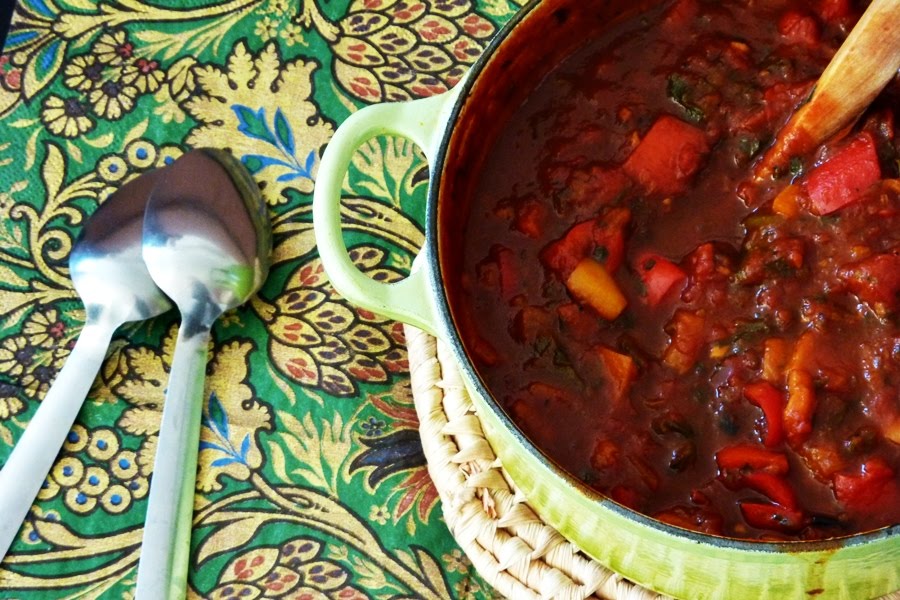

Peperonata, a thick delicious stew of sweet peppers and tomatoes. It is not going to save the world from its tragedies. No, don’t count on that. It will not help a human to stop the Earth plates from moving and colliding, or turn the beastly tsunami waves into harmless ripples, or stop the nuclear reactions at a moment’s notice. Those things are out of peperonata’s reach.

But it can do something for mankind nonetheless. It will cook itself into a sweet and sour bell- peppery-tomato-ey tasty sludge to make one’s mind get away from the misery and sadness and unanswerable questions, be that only for a short moment, and marvel at the priceless simplest things and be grateful for being able to continue to experience them alone and with the loved ones.

Take five sweet peppers: two red, as many yellow, and one green, for color. Deseed and dice them roughly. Chop up one onion, do the same with a few garlic cloves. Sauté the two in a large pot until fragrant, and then send the peppers together with some canned chopped tomatoes to join the gathering. Show the way to the pot to fresh parsley and basil. It goes without saying, salt and pepper should participate too. A few drops of Tabasco would make the whole gathering even more lively. Let the heat do its mingling job for about two hours.


I learned the recipe from Anthony. Upon request and by phone, Anthony’s mother provides him with the recipes he remembers to have enjoyed in the years passed. So far there are three of them, including the one for peperonata, all kept in a thin salad-green fabric-bound notebook. Regardless of the fact that Anthony’s mother hails from the Veneto region in Italy, there is not enough evidence to claim that peperonata is Veneto’s native. I guess it’s safe to say there are as many versions of it in Italy as there are those to cook it. So I’m going to skip any speculations about the original way to make the stuff and will only draw on one Italian mother’s knowledge, of which I am an indirect receiver.

Peperonata
Adapted from Anthony’s mother, Eugenia

The key to a deep flavor here is to let all the ingredients, including fresh herbs, simmer together for up to two hours. This peperonata should be thick, so you don’t want to add any more liquid: there will already be enough of it from the vegetables. Although technically it’s a stew, in this unrepentant household we dubbed it a (pasta) sauce. (Nigel Slater did the same, among much else.)

About serving: Anthony says that in her childhood his mother was used to have it with polenta or sausage (!), the Northern Italian style. We like it with penne or rigatoni. But independent, non-opinionated eaters can devour it with rice, potatoes, or, yes, pretty much on its own with a chunk, or two, of bread.

A few more bits: as stews go, peperonata tastes even better the next day, after all the flavors schmoozed and mingled. I know, I know, sweet peppers are not in season yet. Patch solution: organic “green-housed” ones, perhaps?

3 Tbsp olive oil
1 large white onion, roughly chopped
2 cloves garlic, roughly chopped
5 sweet ripe peppers, halved, seeded and diced
2*400 g (15 oz) canned peeled tomatoes, including juices
1/2 -2/3 cup fresh chopped parsley, finely chopped
6 fresh basil leaves, finely chopped
salt/pepper
a few generous drops of Tabasco, or to taste

1. In a large heavy saucepan, warm up the olive oil over medium heat. Dump in the onion and sauté until lightly brown, 5-7 mins. Here it may be argued that the onion should only take on a touch of golden, no browning. But doesn’t the browned onion mean more flavor? So no worries, brown the stuff.

2. Add the garlic and cook for another minute.

3. Throw in the peppers, follow with the tomatoes and the fresh herbs.

4. Bring to a simmer and bring the heat down to very low. Add salt, freshly ground pepper and Tabasco to taste. Cover halfway with a lid and cook for the next two hours. Make sure to stir every now and then to avoid scorching. Taste and adjust the seasoning if needed. Remember that salt extracts the vegetables’ aromas, so don’t be stingy with it (but don’t go rampant either).

Note: the quantity is enough for about 300 gr (10 oz) dried penne, which amounts to 4 moderate servings.


25 February 2011

Cooking the beef nicely

February, wait up! Wait up, I say!

Gentle Reader, my confusion knows no end. I gave up understanding why those 24 hours that we all know equal a day go rampant and unruly when all you need from them is that they walk beside you, steps measured and in accord with yours. But no. They are like a pack of hunting dogs, unstoppable in their pursuit of whatever. Oh lay, what would you do with this rushing time, so eager to leave you behind, so capable to speed up on and on. I've been thinking a lot about it lately. That and about meat – steak, in particular.


Let me explain.

I'm not a vegetarian. I like a beautifully cooked piece of meat (sustainably and humanely grown, of course) as much as a plate of chickpeas. Yet I scarcely got to eat meat. Mainly because I didn't know how to cook it without turning it into an unswallow-able substance -- sometimes charred, always dried-out. For a while I used to be sure that the cooking of meat is a men's domain. My logic rested on the bones of a fact that generally the man's usual food of choice is a sizzling steak and that, by extension, meant to me that men understand meat better than we women do. Cooking steak is a gender thing, I assumed. Until I made friends with men who, despite their taste devotion to meat, didn't exactly excel at making an edible steak themselves. That unscientific observation of mine triggered a desire in me to find out what it is to be held accountable for a botched steak.

I consider it my fortune to have a chef among Anthony’s and mine friends. It’s a double fortune that this chef friend of ours, Jan-Willem Teunis, is a member of the Irish Beef Club. Meat is no doubt taken seriously in this establishment and so in an effort to stop my steak jinx, I asked Jan-Willem to please teach me the basics of cooking the beef nicely.

Even before attempting, I knew that the path to a mean steak is through the right temperature. Yes, I knew that already. What I wasn’t aware of was the way the heat should get through the meat. This has to happen slowly – and in short intervals.

Here is how to achieve it. The first thing to do is pre-heat the oven to 220 C. Second, bring the piece of sirloin, filet mignon, what have you to room temperature. This step is important, for if the meat is put in the heated pan too cold or frozen, the temperature of the pan will drop. When your beef cut of choice is good to go, the next step will be to “seal” the future steak (to give it color) by cooking it in a thoroughly pre-heated frying pan to which a few generous glugs of olive oil were added. When the oil turns transparent and thin, you add the meat and let it frizzle on each side, broad and narrow, until it takes on deep golden brown hue. As a finishing touch at this stage, throw in a knob of butter, for flavor. While you pour the liquid (use a soup spoon) that accumulates in the pan over the meat, you could take a quick moment to reflect upon the loud sizzling relationship that you see between heat, fat and muscle. The whole step takes no longer than about three or four minutes. At this moment, the steak is rare.

Next, place the meat in a vessel fit for the oven – a casserole dish, or a stainless steel tray, or a small cast-iron pan -- and leave it to rest for a couple of minutes in a warm place (if you used cast-iron pan for the searing, don’t use the same one now: at this point you don’t want the meat to continue cooking, which it will from the heat of the pan). This is done to let the meat relax first before the successive bouts of heat.

Finally, you send the steak in the oven. Two minutes in, four minutes out. Two minutes in, four minutes out. Two minutes in, four minutes out. Two minutes in, four minutes out. Alternating the cooking and resting times ensures that the heat won’t get in the beef faster than needed and that the meat stays soft and juicy throughout. Feel your steak now: if it springs back the way the flesh between your thumb and index finger does when poked, the steak is medium rare. If you want it medium or well-done, continue cooking it in said intervals up to seven or eight times. My last steak was done medium-well already after the fifth time in the oven. Be watchful and careful here, is all I’m saying. Poke the meat as you go, it shouldn’t feel shoe-sole-like to the touch. But of course you know that. Some salt and pepper and a small pour of fragrant olive oil over the finished steak – and you are in business now.


One of the things I find admirable about food is that once you’ve had a meal you thoroughly enjoyed, with dear friends or all by yourself, it is able to envelop and seal the fleeting moment into a cherished memory, a memory of laughs shared, of bites relished, of knowledge passed on.

14 January 2011

I took the bait


It is my impression that if one learns where I come from (Russia), vodka is what most likely will spring to the inquirer’s mind. One might even take it further as to try to ask me if my mother fed me vodka as a child. Just so if you are questioning the latter, let me tell you that a couple of years ago, at the start of my studies in Amsterdam, a Dutch lecturer of English wondered out loud in class if Russian parents tend to nourish their babies with vodka. How is that for tact?

As you might have guessed, this was what’d been gnawing at me profusely. It is unfortunate, I thought, that the prejudices and stereotypes overrule the real state of affairs regarding the drinking habits of Russians. Please, don’t get me wrong. I’m not saying that the abusive consumption of vodka by Russians is a thing unheard of in and out of the country. What I’m driving at is that there are millions of Russians who do not substitute their daily intake of water with vodka, or other alcoholic beverages if at that.

The cultural shame prompted by the foul stereotypes did very little for me to think of vodka as a fine drink. In my eyes, vodka was a villain and I wanted to avoid it, point. Holy smoke, I did pretty well on that front. Take this: my first contact with vodka occurred just a year ago in a cocktail bar here in Amsterdam where Anthony and I, overtaken by curiosity to try interesting items on the menu, laid our lips on vanilla vodka, a drink mistakenly imagined (emphasis on mistakenly) by us as a sweet concoction of something syrupy and vanilla-y fortified by vodka. Turned out it’s wise to ask your bartender about what constitutes your cocktail as it is generally clever to shoot a few questions over the bar before ordering. What we learnt empirically was that vanilla vodka, at least in the version we tried, is as savory as savory can be: plain vodka mixed with a touch of pure vanilla extract. No sugar, nothing sweet. Woof!

But shame is on me for digressing…

To be able to tread on the treacherous ice of stereotypes, I figured I should equip myself with some protective knowledge to stand my ground when confronting an occasional vodka remark. I was glad to learn that my country of origin does not seem to be the leader in the field of producing the booze in question. Check this out: the production of vodka -- wheat, rye, potato, rice, cane sugar, grape, younameit type -- fastened the globe all around, from Canada to Vietnam. You get my drift? Theoretically not only Russians are prone to the excessive vodka intake, is my point.

I’m sorry – does all that sound somewhat fired up? I guess I must learn that ultimately it’s up to me to decide how to deal with the stereotypes. I can’t force one to change their opinion, that’s no news to me. What I can do is loosen up my attitude. I either can flip the lid trying to verbalize my objections, or alternatively I can lean back on my couch, my feet on an ottoman, and enjoy the fact that vodka exists in the first place. You see, without vodka there would be no Moscow Mule. And without Moscow Mule…I don’t know what we all would do without it.

Ladies and gentlemen, please meet Moscow Mule: an elegant cocktail of vodka, fresh lime juice, ginger beer, and ice. My endless thanks for the original creation go to a trio of Americans: John G. Martin, John A. Morgan, and Rudolf Kunett, each of whom was involved in spirits production or distribution. The three friends gathered up one day in New York’s Chatham hotel in 1941 and, fuelled up by a few drinks and hors d'oeuvre, got overtaken by an adventurous genius. Some ginger beer, some vodka, some fresh lime juice, and voila, served on the rocks, the first Moscow mule made its appearance. The first part of the cocktail’s name – Moscow – is a wink towards the land of vodka. But there are no mules in Moscow, as if you had to ask. It’s named so because of its inebriating properties: it kicks like a mule, as it were.

The photo above is a home-made Moscow Mule. Photography of thatkind is what I make when my vision gets thoroughly fogged by an immodest amount of alcohol and my hands wobbly from the excitement to rush out on the balcony to watch the loud, noisy, mind-splitting, sky-unzipping, glorious New Year’s fireworks.

Speaking of New Year’s, Anthony and I, having had a blast over the Christmas dinners at friends’, decided to spend the New Year’s in the setting of our home – I don’t recall my mentioning that past November we again moved houses; it’s a high-rise and we are on the eighth floor with nothing above our roof but the endless sky -- where we enjoyed the society of a bottle of vodka that yielded innumerous, for the two of us, Moscow Mules. Delicious!

My very special thank you goes to a mixologist from a local speakeasy-style cocktail bar, Door 74. His name is Timo and in my eyes he is a true alchemic: he turns ordinary spirits into cocktails which are nothing less than gold. One day early December last year, Anthony and I got seated at the bar in Door 74 ready to watch Timo in action, which is – I’m sure – akin to observing a three Michelin-star chef at work. A new season cocktail menu had just gone into effect. There were many drinks I tried and liked. But none of them I liked as much as Moscow Mule. I didn’t have any knowledge about the cocktail before, but the ingredients (other than vodka) listed in the description and the name piqued my curiosity. I took the bait.

One Moscow Mule for me, please!

Dressed in a sleek black three-piece suit, with a tie-clip in the shape of a sword, Timo nodded his approval and took a copper mug from the fridge. Cubes of ice twice the size of a standard game die made their way into the vessel. The juice of half a lime was squeezed into the mug, into which Timo poured some vodka and finally ginger beer just enough to top it all up. A few stirs later and I was given a drink – zestful, zingy, refreshing, spicy stuff -- that would change my relationship with vodka for good.

Next time I’m asked what my parents gave me as a child, I’d non-hesitantly say, “Oh I wish they’d have given me Moscow Mules!”

Moscow Mule
Inspired by Timo Janse

Despite the simplicity of this drink, there are a few things that can detour you from a well-balanced result. First: ice. It’s important to use it, a lot and preferably in big cubes (big cubes melt slower). Our first home-made Moscow Mules were without any, which made them taste “rough”, as if the individual components of the cocktail didn’t want to agree to play in a team, each trying to be more distinctive than the other. The ice, as impossible at it sounds, brings all of them together.

Second: ginger beer. It should be pronouncedly sweet to even out the non-sweet-at-all lime and vodka, and spicy to perk things up. Old Jamaica ginger beer is the name of the game.

Third: glass. Originally Moscow mule was to be served in copper mugs; one of the inventors of the beverage owned a copperware business. But these babies are quite costly. So if you don’t own one, it’s not the end of the world. Use a tall glass instead. Just be aware you might want to adjust the measurements depending on the size of your glass. Basically, you mix one part vodka with one part fresh lime juice. The amounts I give below are fit for a 300-ml (10-oz) tall glass.

And finally, it’s imperative that vodka you use for this concoction is on the smooth end of vodka spectrum. If you can, use a high-end vodka brand with a smooth taste, such as Ketel One or Grey Goose.

Serves 1
ice cubes
20 ml (0.75 fl. oz) vodka, such as Ketel One
juice of half a lime
ginger beer, such as Old Jamaica


Fill a tall glass with ice. Add vodka. Take a half of lime and if you don’t have a professional squeezing tool that bartenders use, take a strong pair of salad tongs and squeeze the lime to its fullest. Chuck the squeezed lime into the glass. Top it off with ginger beer; stir well. Enjoy responsibly!


28 December 2010

A good friend


Between my work and Christmas dinners, now is the time that I check in to wish you, Dear Reader, a happy holiday season!


May 2011 be a good friend to you!

I'll be back shortly with a beverage.

30 November 2010

The way I see it

There comes a time in every person’s life when they totally refuse to accept the dark side of their highly dignified self and wish for a theory to justify their less than a self-flattering behavior. Almost always there is no such thing and an individual just ought to suck it up and admit to being an ass every once in a while (and hopefully not any frequenter).
Not entirely by design, yet not by accident either -- I get greedy for food that I like. Because I couldn’t find any theory to justly explain why I act the way I do, I had to make up my own behavioral theorem. I named it a favorite dish theory (FDT) and it goes something like this. Upon finding his/her favorite dish, a human undergoes two stages of behavior. The initial stage is mostly anti-social and can last at least for the first few days after an individual discovered the recipe. During these days, one is prone to cancel long-awaited appointments, is unable to strike a coherent conversation, develops an appetite that cannot be quelled if the dish isn’t there, and, most importantly, refuses to think about sharing the dish with anybody. The latter can progress to the extent that one is even willing to pick up quibbles with their significant other -- I don’t like your voice when you say my name, don’t talk to me! -- to temporarily ensure a solitary eating experience for one to enjoy the food one so mind-wrecking-ly fell for. Friendships and relationships are running a risk of rupture.

It is only after one starts to want to talk non-stop about the dish with others that the second phase begins. It is, quite contrary to the earlier days, marked by an obsessive wish to share. One now wants to cook the dish for everyone. Friendships and relationships get mended; their shredded parts are sewn together by the food which had torn them before.

The way I see it, the FDT is a brilliant thing. It has this golden property: it saves face for me. Now nobody has rights to think of me as a greedy selfish pig. The FDT explains my bad manners nicely.


Two weeks ago I ran into this recipe for chickpeas in date masala. Since then I’ve been referring people who came in direct contact with my kitchen table to my theory (better than the overrated saying sorry for being inconsiderate).
Chickpeas…I get emotionally scarred when I don’t have a meal that involves chickpeas at least twice a week. That’s surprising, somewhat, seeing that I properly acquainted myself with the beans in question just two years ago, soon after I’d move to Amsterdam (in Russian cuisine, chickpeas are scarcely used). But anyway…I don’t cringe to eat them canned straight from a tin, the lid pulled up and curved. Briefly sautéed with caramelized onions, chickpeas don’t seem to bore me. In the society of mellowed by heat fatty chorizo, the chickpeas win my rambling heart time and again. But no matter how much I like those combinations, they don’t trigger my ill manners. What does, however, is chickpeas dishes of Indian heritage/influence. Those spices, that heat…aww!
I can see I may come off a little bit kooky here, what with my admiration for this edible legume. You ask what’s so good about it. To me, the chickpea is bestowed with a mild taste and decent flavor, it is the most neutral-tasting bean I know of. They accept exotic flavors gladly and with grace, is what I’m saying. Which, after a circuitous roundabout, brings us to the discussion of the afore-mentioned adorable chickpeas in data masala.


No yogurt or tomato sauce goes into making of this dish. It’s solely about chickpeas and spices. To make the stuff, one is required to interchange two actions by the stove; roughly it is heating and adding. First you heat up some vegetable oil and then you add a chopped onion. You cook it until the onion becomes soft and browns up a bit. After that some garlic and tomato paste are added. A minute or so after, chopped dates, cumin, cardamom, cayenne and black peppers dive in. Lastly, some chickpeas along with a splash of water are added. It’s all heated up again. Now it is ready eat. How easy is that?
 Taste-wise, it’s simultaneously sweet (dates) and savory (cumin), the two tastes bridged by the ethereal cardamom, which itself is at once sweet and savory, and when you think you’ve got it all, there is also a swoosh of heat (chilies) catching up with your taste buds, rushing from the tip of your tongue all the way down the throat. Besides the glorious chickpeas that soak all that up, the dates, after swelling from heat and a bit of water, also turn into chewy capsules of taste that can be best described with one word – savourysweet.
 Something tells me I should courteously finish off this post by saying see you later and stuff, but I’ll skip that. I’m in a hurry to my kitchen for another helping of the chickpeas in date masala. Why should I care to be polite when I have my favourite dish theory to excuse the moments when I am not?


Chickpeas in Date Masala
Adapted from The New York Times

The original recipe uses star anise (or alternatively, ground anise) as a finishing touch to the dish. Personally I am not a big admirer of anise’s licorice flavor, so I passed on.

3 * 400-grams (15-ounce) canned chickpeas
2 black cardamom pods (I used green ones)
1/3 cup non-fragrant vegetable oil
1 large yellow onion, finely chopped
6 cloves garlic, minced
2 ½ Tbsp tomato paste
9 dried dates, potted and roughly chopped
4 tsp ground cumin
2 tsp table salt
1 tsp ground cayenne (you can use fresh chili instead), or to taste
1 tsp freshly ground black pepper, or to taste
2 whole star anise, or 1/3 tsp ground (optionally)

1. Drain and rinse the chickpeas under cold water. Set aside in a bowl.

2. Using a knife, crack the cardamom pods. Discard the shells. Using a mortar and pestle or a coffee grinder, crash or grind the seeds. Set aside.

3. In a medium pot, warm the oil over medium-high heat. Add the onion – it should sizzle – and cook for 8-10 mins until it has softened and starts to brown. Stir in the garlic and cook for another minute. Dial the fire back to medium and add the tomato paste. Add the cardamom, dates, cumin, salt, cayenne, black pepper, anise (if using) and cook, stirring often, for 2-3 mins.

4. Add the chickpeas and ½ cup or a little bit more of water, just enough to make them less than dry. Warm up the mixture, stirring occasionally, to let the flavors incorporated. Remove from heat. Serve warm. (I ate the stuff plain on its own, but it is not a bad idea at all to accompany it with rice, or flat bread.)

13 October 2010

It makes me overwhelmed

A while ago I chanced upon a blog post in which its author gave an inspirational account of her stay in Amsterdam. Seeing that I live in Amsterdam, I didn’t intend to seek out travel stories about Amsterdam, just so you know, but as I saw the title – There was Amsterdam – I thought it would be ignorant of me to pass it up, especially if posted on a food blog as delicious as Sweet Amandine. So I dived into the story curious to learn about what my adopted city showed to Jess (the Sweet Amandine’s creator) and her husband, Eli, during their stay in Amsterdam this past August. I don’t think it makes any sense for me to retell the whole story here. Please read the original, it’s a treat. For our purposes, what I want to tell now is that there was a moment in the story that gripped me quite tight. Right there, in the spot between the eighth and the thirteenth paragraphs my heart came to a screeching halt, did some crazy summersault, and tumbled on with excitement all the way towards the final full stop of There was Amsterdam. And all that is because Jess talks about the bakery. My bakery! As I was re-reading the post in question, I couldn’t help but repeat to myself how bizarre this felt to hear somebody else tell their story about the bakery. Usually I talk. Now I listened.

Since I read Jess’s post, I’ve been thinking a lot about my own story – but not about the bakery. I’ve been thinking about my story in the bakery. About how I started off – and what I am gradually becoming. It wouldn’t be honest to say that it was my initial goal to work in the bakery. I considered myself a loyal customer, the type that wouldn’t mind to cycle forty minutes one way in the rain just to get, say, a loaf of fresh baguette. I admired Issa and Marco, the two brothers Niemeijer, for making that excellent food that like a magnet would attract me no matter what; for creating and running a place that instantly becomes everybody’s favourite haunt. I enjoyed the role of an observer, I guess I could say that, coming in a few times a week to say hello and offer my thanks in my deconstructed Dutch (and then to giggle awkwardly when they replied back in fluent Dutch). I weaved my social life around that place: I brought my then dates and a couple of good friends for lunch there, all at respective times, should you ask. I didn’t intend to apply for a job there, though. Until I found myself, as a then student, in need for a part-time job – badly.

The circumstances conspired in such a way that there was a vacancy in the bakery back then. I took the job. I started off as a dish-washer. It was a touch more than a year ago. Although doing the dishes was my priority, I couldn’t help but poking my nose into the bakery’s activities. I was open with Issa, a baker, and Marco, a chef, about my plans to be a professional food-writer, the one with a hands-on approach, as I reasoned. As a starting point -- and I already touched upon it here -- I was shown how to make tartlets. I had to learn to beat the bejesus out of the tartlet dough (pate sucre) to soften it; to remember the steps of rolling it out with the
dough sheeter; and finally, to get the trick of molding the rounds of the cut-out dough into tartlet shells fast -- very fast. If I’d take my time to do that, the dough would then become sticky, very difficult to handle. At the beginning it felt like a military camp, somewhat. Instead of doing push-ups and sit-downs, I’d make tartlets with a timer counting away precious minutes beside me. One day, I remember, it was suggested I make approximately sixty to eighty tartlets in no longer than fifteen minutes. I think I did the “tartlets boot camp” well. To make tartlets fast is no problem anymore. To make them swiftly is relaxing now.

After I’d made myself comfortable around tartlets, I moved on to learn the making of a tarte Tatin. The most challenging part was to arrange thin apple slices in a way so that they, still standing on their curved ends, would overlap each other neatly.


To be clear: it’s not that difficult of a task. But there is a catch. If you don’t use enough apple slices, once baked they will shrink and reveal the dough underneath, the way the hair on the head can thin out and show the skin (ouch!). Conclusion: it’s important to use a good amount of apple slices, say, three apples’ worth per pie, to make sure that a Tatin looks as close to immaculate as possible. Warning: tucking in the apple slices next to, and in between, each other in a careful fashion requires some time, from five to seven minutes, I found. This is a potential material for trouble, because it’s a general policy here that you shouldn’t spend too much time on one thing, otherwise you create sort of a jam in your own work flow.


After about six months in the dish-washing job, getting a hands-on approach only occasionally depending how many dishes I had to do at a given moment, I thought I should carve out some time that I would spend solely on working in the bakery. Could I possibly get an apprenticeship, I asked. This past February I became a baker’s apprentice.

The writing of this post doesn’t come easy to me. For one, because there are so many things I want to tell. It makes me overwhelmed. It feels like my brains are a pot of boiling water, thoughts being the bubbles. Should I mention how I learnt to make that crème au citron that requires the non-stop ten-minute whisking? How could I not mention croissants and the challenge that comes with making them? On days when we are fast enough as to not let the butter start melting into the dough (a tall order when working next to the piping-hot ovens) before baking, the croissants puff up so beautifully in the oven that all those layers of dough, being risen by the steams from the melting butter (that’s why the butter should not melt any time earlier) make you want to stand by the oven, ignoring all the hiatus that may be all around, clasp your hands and murmur, wow, they can rise that high! If it so happens that you absolutely have to bite into such a wonder, you incidentally drop one on the floor. In this event, it can’t be served to customers. The floor is clean, so you knew what you were doing – you got yourself admittedly the best croissant Amsterdam can offer.


In September it came time for me to get myself acquainted with the bread dough. The order in which the ingredients are added can vary depending on the bread, but normally you mix flour with water and sourdough, let the mixture rest, then add salt, mix it all again, and, equally divided on the scales, put it in plastic boxes for a rise. Nothing incomprehensible or undoable. Except that the dough is heavy. Very heavy. Miss Paola – my fellow woman baker, my friend! -- metaphorically compared the process of taking the dough out from the mixing machines to the “pulling an overweight kid, who strapped themselves in velcro just to make sure you can't move them from the playground”.

Reader, I would go on like this for hours, hopping from one thing to tell to another. But generally speaking, as I think about the way I made it in the bakery starting, basically, from scratch, I feel proud. It’s not oh-look-what-I-can-do kind of pride; it’s pride that silently sits in the corners of my mind waiting to be called in every now and then to remind me not to be so harsh on myself on the occasions when, for example, a bowl of chocolate ganache incidentally slips from my hands and lands on the floor, chocolate ricocheting in all directions and covering pretty much everything in the radius of three meters, including that dough sheeter that Issa has to use for the rolling out the croissant dough, like, now; and my face, in such a way that I look like a Moulin Rouge girl, what with the artificial moles around my lips and on my cheeks.

Of course all my achievements, past and present, come with a price. Working in the bakery five days a week now, starting earlier than the sunrise, is exhausting-- just as much as it is rewarding. Daily baking/preparations programme is intense, with no wing room, so to speak. So it is no exaggeration to say that the only moment of rest we have during the day is a fifteen-minute lunch break, which is almost always punctuated by the oven’s beeping, which means it is time, right now in the middle of a recess, to take whatever was baking out of the oven. As you can imagine, this way a so much needed break flies past us unnoticeably.

Yet, that exhaustion also comes with an incentive. It is the realization that the bread and pastries we make in the bakery can be a source of happiness for many. It fills you with contentment and makes you “hit the floor with your ass”, as Charlie, one of our bakers, says, meaning that it makes you happy. Only being French, Charlie has a difficulty pronouncing the initial “h”, making it sound like “eat the floor with your ass”! Either way, it sounds very appropriate, I find!

2 September 2010

I would love to


Dear Reader, my drama with that chocolate cake (remember?) is over.

As a foreword, let me tell you that I made the cake ten times within the past fourteen days, which means the cake was seen in my kitchen almost daily for the last couple of weeks. I would love to explain the cake’s frequent appearance by its exceptional taste, so exceptional that each time the sweet thing was gone sooner than I could bring it to the table. Oh how much I would love to say that all that is true. But brother, it’s not! This cake, it was unruly. It drove me crazy. It exhausted my patience. I’m not exactly happy to relay all this, but nine times out of ten I flipped it the finger and furiously sent it into a trash bin. Why I kept making the stuff was that I can be stubborn -- if I want to. And I love chocolate cake. Plus, I believed a Moosewood restaurant cookbook that said that this six-minute chocolate cake is “an economical, low cholesterol, delicious dark cake that goes into the oven in 6 minutes with no mixing bowl to clean, because the batter is mixed directly in the baking pan”. I want to think that somebody somewhere did as the recipe has them to -- and loved the results. Me, I only made my trash bin full.


The only thing that I can agree with is that the cake is “low in cholesterol”. True -- no eggs, no butter, just vegetable oil. I would think twice before nodding in agreement about the creation being “economical”, as the recipe advertises. Good-quality cocoa powder (you need it for the batter) is not entirely inexpensive, right? The same goes for chocolate (you need it for the glazing). So calling the cake “economical” is not fully accurate, I noticed. As to the deliciousness of the cake, well, the past few weeks I spent nearly all my free time looking for it, that deliciousness. I found it not.

Like I mentioned, the recipe comes from a book by the Moosewood restaurant collective Moosewood restaurant cooks at home whose primarily focus lays on the food that’s fast and easy to make, and above all, the food that’s natural (Moosewood restaurant is a natural foods eating establishment).

(I borrowed the book from my baker boss Issa Niemeijer who is a vegetarian. When it came time for me to return it and I hadn’t yet copied said chocolate cake recipe, I hastily made a picture of it. I couldn’t wait to make this cake.)


I feel I should say now that I made it a point not to deviate from the original recipe too much. The cake was intended to be simple and quick. Its main ingredient is unsweetened cocoa powder, no chocolate in the batter. An innocent observer could now notice that I could have used chocolate ganache or chocolate chips in addition to the cocoa powder to try to make the cake close to being heart-rate accelerating, but I chose not to. If I did, it would not be that “economical, low cholesterol, delicious dark cake” any more, was my reasoning. I didn’t want to complicate anything about the stuff. I just hoped it’d be delicious. Alas, it never tasted as much to me. Reader, I don’t want to come off as a Negative Nancy around here, what with all the complaining and everything. The cake wasn’t bad. But it didn’t cut it for me, either.


As I said, I didn’t inject the cake with the ganache and whatnot. Yet, in my desperation, I kept adding things to it -- such as lemon syrup which I’d spoon over the cake before covering it with chocolate glaze -- trying to make the cake flavorful and interesting, attempting to create a bomb of flavor out of it. But now as I think of it I can see I kept forcing this cake to be what it’s not. In a few brushstrokes, it’s an easy cocoa-based cake whose attraction may be hidden deep down its nude simplicity. On its own, cocoa can never be as rich in flavor as chocolate, but I didn’t want to see it then. I had my grand expectations which would never match what this cake is all about: decency. Instead of accepting it, I was getting continuously upset: it’s not what I want it to be, it’s not what I want it to be, it’s not what I want it to be. Finally, I figured it’s better if I stop looking for something that’s not there. I’m not going to make this cake anymore.


Yet, I’ll post the recipe. Maybe somebody will get to make it, and will love it, and will tell me that I am crazy to “dis-love” it.


Six-Minute Chocolate Cake
Adapted from Moosewood restaurant cooks at home by Moosewood collective


Despite it being said in the book that the cake batter “can be mixed directly in the baking pan”, I’d recommend you don’t do that. It’s not entirely convenient to try to mix the batter in a square cake form; a good amount of flour can be left unincorporated in the corners of such pan. Of course if you are using a round baking pan, that’s not a problem anymore. Yet, it’s better to first mix the wet ingredients together in a separate bowl, this way you will not over-mix the batter adding wet ingredients one by one. For those reasons, it’s better to use two separate bowls – one for dry and another for wet mix. Which, I agree, is at odds with the original idea for the cake preparation to be only six-minutes long. Still, a few more bowls notwithstanding, it’s fast to whip up.

Dry mix
1 ½ cup unbleached all-purpose flour
½ cup unsweetened cocoa powder
1 tsp baking powder
½ tsp salt

Wet mix
1 cup buttermilk
1 cup light brown sugar
1 tsp vanilla extract
½ cup non-fragrant vegetable oil

Bittersweet chocolate glaze
½ pound (250 grams) good-quality bittersweet chocolate
¾ cup warm milk

Preheat the oven to 165 C (365 F). Butter a 8-inch square or 9-inch round cake form.


In a medium bowl, sift together the flour and salt; mix well. Continue sifting in the baking powder and cocoa powder. Mix again.

In another medium bowl, whisk together the buttermilk, sugar, and vanilla extract. Whisk in the oil. With a spatula, stir the wet mix into the dry mix just until incorporated.


Pour in the prepared cake form and bake for 40-50 mins, or until a toothpick inserted in the center of a cake comes out clean. Let cool for 15 mins. Take out from the cake form and put on a wire rack.


While the cake is cooling down, prepare the chocolate glaze. Melt the chocolate in a heatproof bowl set over a pan with boiling water. Once the chocolate is melted, stir in the warm milk. Spoon the glaze over the cooled cake. Refrigerate for at least 30 minutes before serving (as you can see from the photo, I didn’t wait that long.)